
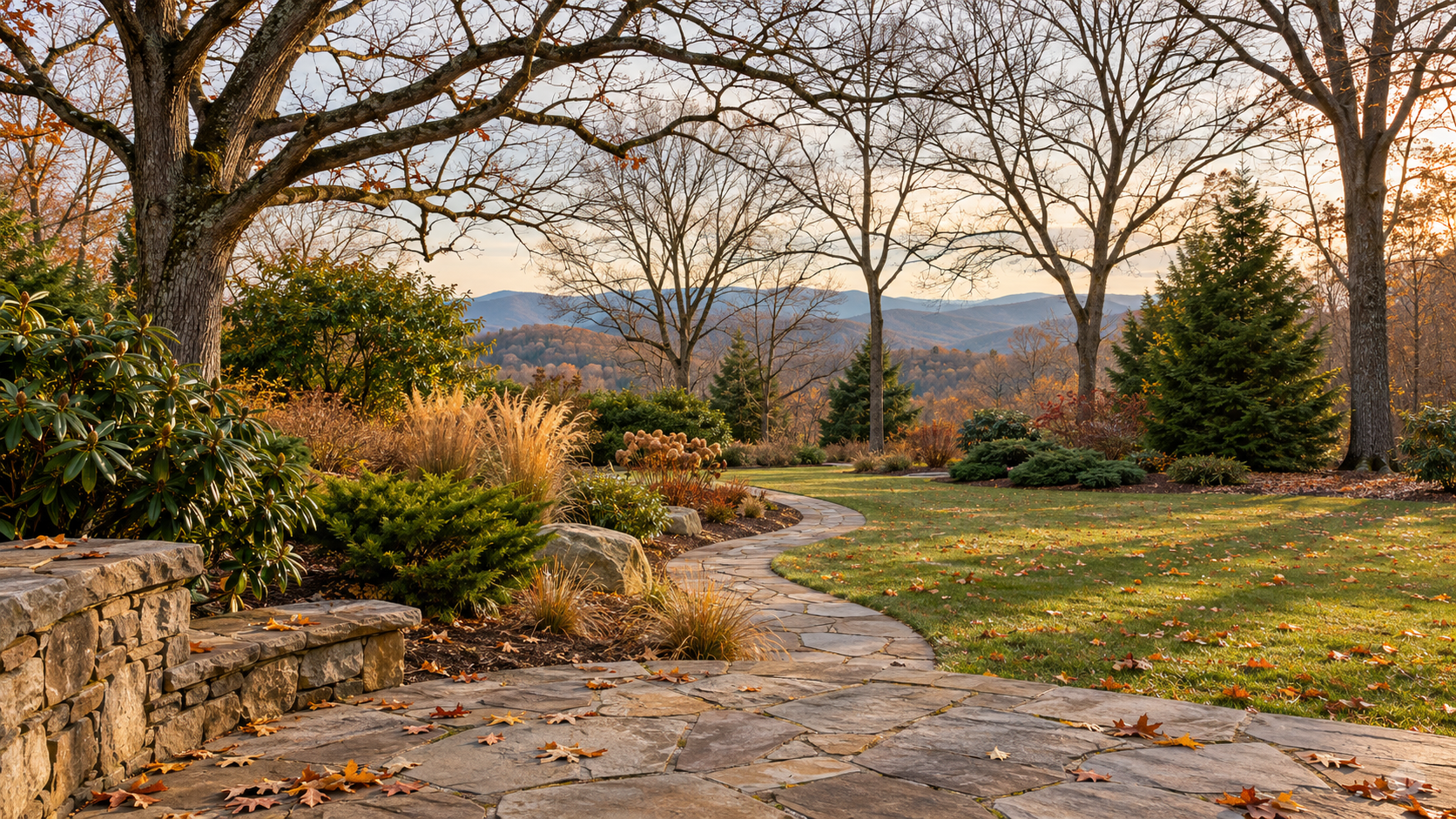
A full canopy can make a landscape feel lush, private, and complete. But when November leaves begin to fall, the view changes. A foundation that disappeared behind summer foliage becomes visible. A gap between planting beds suddenly feels larger. An area that looked balanced in July may seem disconnected by Thanksgiving.
That newly exposed view is useful. It reveals how your landscape works when flowers and foliage are no longer doing most of the visual work.
At Snow Creek Landscaping, we see this seasonal transition as an opportunity to look beyond individual plants and evaluate the design as a whole. For homeowners in Asheville and across Western North Carolina, late fall offers a clearer perspective on spacing, foundation plantings, and the structure that carries a landscape through winter.
Look at the Landscape From the Places You Use Most
Start with the views you experience every day. Stand near the street, walk toward your front entrance, and look out through the windows of your most-used rooms. Spend a few minutes on the porch or patio, too.
Instead of asking whether everything still looks green, consider a few more useful questions:
Does the entrance remain easy to see and welcoming?
Do planting beds feel connected to the house and one another?
Are there exposed areas that draw attention away from more attractive features?
Does the landscape still have a clear focal point?
Has leaf drop revealed a neighboring driveway, utility area, or other unwanted view?
Take photographs from each location. Images can make uneven spacing and empty stretches easier to recognize, and they give Snow Creek Landscaping a useful starting point when discussing improvements.
Awkward Spacing Becomes Easier to See
Summer foliage can blur the distance between plants. Once that foliage drops, the underlying arrangement becomes much more apparent.
You may notice several shrubs crowded together at one end of a bed while the other end feels unfinished. A small ornamental tree might seem disconnected from nearby plantings. Individual plants may appear scattered across a large mulch bed without enough repetition to bring them together.
However, an open space does not automatically need another plant. Young plants need room to reach their mature size, and intentional openings can keep a design from feeling crowded.
The important distinction is between space that serves the design and space that makes it feel incomplete.
Snow Creek Landscaping can help evaluate whether an awkward area needs time to mature, a change in plant placement, or a more cohesive planting arrangement. Sometimes moving or simplifying existing plants creates a stronger result than adding more.
Bare Foundations Reveal Problems With Scale
When deciduous shrubs lose their leaves and perennials die back, the base of a home can become surprisingly prominent. Long stretches of exposed foundation, tall blank walls, and abrupt transitions between the house and surrounding beds may suddenly stand out.
Foundation planting should help connect the building to the landscape. That does not mean creating a solid hedge against every wall. A successful design can combine open space, evergreen foliage, deciduous plants, and varying heights while still making the home feel grounded.
Look for places where the proportions feel off:
Low plants beneath a tall, uninterrupted wall.
A narrow planting bed beside a large home.
Shrubs that hide windows while leaving nearby areas visually bare.
Plantings that stop abruptly at a corner.
These situations may call for a wider bed, a different balance of plant sizes, or a carefully placed tree or shrub. Snow Creek Landscaping considers the architecture, available space, and growing conditions together so that improvements fit the home as well as the site.
Notice What Still Gives the Landscape Shape
A landscape with strong structure remains visually organized after leaf drop. Your eye still knows where to go, and the property continues to feel intentional.
That structure can come from several sources: evergreen plantings, branching patterns, stone walls, bed edges, pathways, steps, and well-placed trees.
If the landscape seems to disappear every November, it may rely too heavily on seasonal foliage and flowers. Adding structure can help, but the answer is not necessarily to fill every opening with evergreens.
A few thoughtfully positioned evergreen groups may provide enough visual weight. A small tree with an attractive branching habit can create a focal point. A more defined walkway or a better-shaped planting bed may bring order to an area that previously felt scattered.
Snow Creek Landscaping can help identify which elements will make the greatest difference without overwhelming the space.
Reassess Privacy After the Leaves Fall
A summer screen and a winter screen can be very different things.
Deciduous trees and shrubs may provide welcome privacy during the growing season while allowing clear views through the property in November. That seasonal openness may be perfectly comfortable along a woodland edge, but less desirable beside a bedroom window or frequently used patio.
Evaluate privacy from the location where it matters. Sit in the chair, stand at the window, or walk the path you want to screen.
Then identify the specific view that needs attention. A focused planting may solve the problem more effectively than a continuous row along the entire property line.
Snow Creek Landscaping can help develop a screening plan that accounts for winter coverage, mature plant size, sunlight, and the mountain views you want to preserve.
Leave Room for Winter Beauty
A November landscape does not need to resemble its summer appearance to be successful.
Exposed branches, textured bark, ornamental grass stems, and the outline of a stone wall can become more noticeable and appealing as leaves fall. Open views can also reveal distant ridgelines or bring more light into the home.
Before labeling an area “empty,” ask whether it offers something valuable in this season. The goal is a landscape that feels considered throughout the year, with different features taking their turn.
Turn This Season’s Observations Into a Better Design
You do not need to solve every issue at once. Start by identifying the two or three views that feel least resolved. Photograph them, note what bothers you, and consider how you want those spaces to look and function.
Whether the next step involves reworking a foundation bed, improving privacy, or adding year-round structure, those observations can guide a more focused plan.
Snow Creek Landscaping can help you turn November’s clearer view into thoughtful improvements for the seasons ahead. Contact our team to discuss a landscape design that feels connected, balanced, and welcoming—even after the leaves have fallen.
