
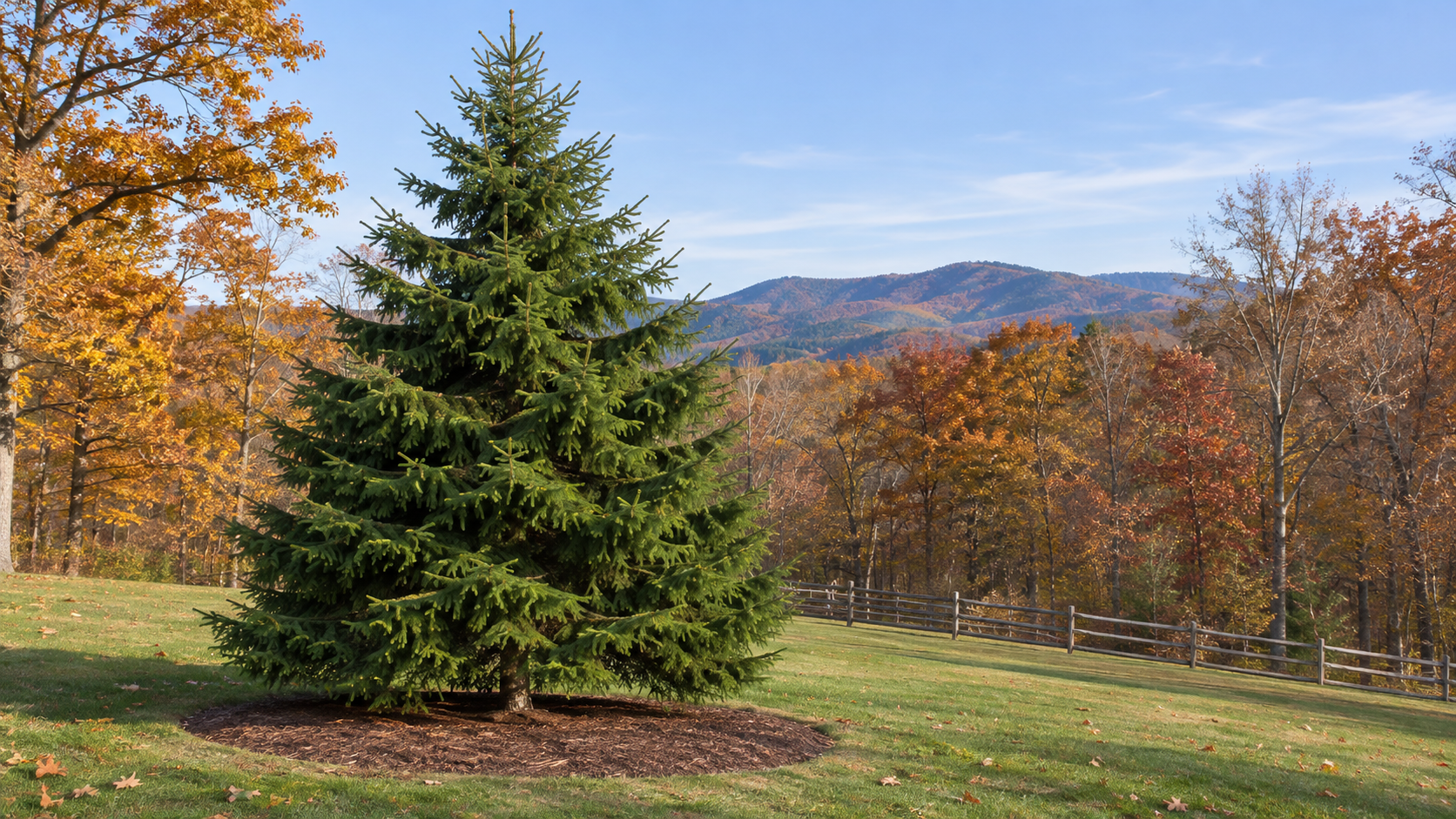
When autumn color fades, the landscape begins to reveal its underlying structure. Tree trunks, branching patterns, open spaces, and evergreen forms become more noticeable.
For some Asheville homeowners, that quieter view highlights something missing: a substantial tree that gives the property a sense of permanence.
Norway spruce can fill that role in the right setting. Its dark green needles and distinctive form bring a classic evergreen presence to a landscape, offering a visual anchor that remains after surrounding trees lose their leaves.
November is a useful time to consider where a tree like this might belong. At Snow Creek Landscaping, we look at evergreen installation as an opportunity to shape how a property will feel for years to come.
With Norway spruce, that begins with choosing a location worthy of its eventual size.
What Gives Norway Spruce Its Classic Character?
Norway spruce has a recognizable conical form when young. As it matures, smaller branches hang from its main horizontal limbs, giving the tree a more graceful appearance. Its evergreen needles provide a dark backdrop throughout the seasons.
That character can support several design goals. A spruce might anchor a broad planting area, provide a background for smaller ornamental plants, or create a strong focal point viewed from the home.
Its value also comes from contrast. Imagine a dark evergreen behind the lighter branches of a deciduous tree, or beside a planting area that changes color through the year. The spruce provides continuity while the surrounding landscape shifts.
For a property that feels visually scattered, one thoughtfully positioned tree can help organize the scene.
Think in Decades When Choosing the Location
The most important consideration with standard Norway spruce is scale.
Virginia Cooperative Extension describes a typical mature tree as approximately 60 feet tall and 30 feet wide. Individual trees vary, but those dimensions make clear that this is a large evergreen.
A young tree near the front corner of a home may look balanced initially. Over time, the same location could create a conflict with windows, rooflines, walkways, or adjacent plants.
Before installation, consider:
How much open space surrounds the proposed location?
Will the tree’s eventual spread extend across a driveway or boundary?
Are overhead utilities present?
Which views should remain open?
How will the tree relate to the house as it grows?
Is there room to appreciate its natural form?
Snow Creek Landscaping can help homeowners evaluate these questions before a planting decision becomes a long-term maintenance problem.
The right location allows the tree to contribute to the property without overwhelming it.
Use Norway Spruce Where Its Scale Adds Value
A large evergreen can be especially effective when the landscape needs a substantial visual anchor.
An expansive open area may benefit from a tree that brings proportion to the space. A distant boundary may offer an opportunity to create a green backdrop. A broad view from the home might feel more balanced with an evergreen positioned to one side.
Norway spruce can also be used for screening where sufficient space is available. Virginia Cooperative Extension identifies both privacy screening and background planting as appropriate uses.
However, screening does not always require a continuous row. Depending on the sightline, one tree or a small grouping may provide the desired effect.
The design should begin with the view you want to improve. That approach helps determine whether Norway spruce is the right choice and how much planting is actually needed.
Match the Tree to the Site
A generous planting area is only part of the equation. Light and soil conditions matter as well.
Norway spruce is best considered for a sunny location with well-drained soil. Site suitability should be reviewed before installation, particularly where water collects or the surrounding landscape shows signs of drainage problems.
For Asheville and Western North Carolina properties, that review should focus on the specific planting area. Two locations on the same property may have very different growing conditions.
An open slope, a sheltered lower area, and a space beside a driveway should not automatically receive the same planting recommendation.
At Snow Creek Landscaping, a site-based approach helps connect the tree selection to the conditions it will actually experience.
November Makes Landscape Planning More Revealing
Once surrounding foliage thins, it becomes easier to study the relationships between existing trees, buildings, and open areas.
You may notice that the home needs a stronger visual connection to a distant planting bed. Perhaps a broad side area feels unfinished. Or the view from a favorite room could use an evergreen focal point.
These observations make November valuable for design decisions.
Fall can also be a favorable time to install trees while conditions remain suitable. North Carolina Cooperative Extension identifies fall as an important planting season, allowing root development during cooler weather before the following summer.
Installation timing should still reflect local weather and soil conditions. A calendar date alone does not determine whether a particular site is ready.
Give a New Evergreen a Thoughtful Start
A substantial tree deserves careful installation.
The planting process should account for the root flare, root-ball condition, planting-hole dimensions, and surrounding grade. Mulch should cover the appropriate soil area without being piled against the trunk.
After installation, watering remains part of the project. Newly planted trees need regular checks because their roots have not yet established throughout the surrounding soil.
A practical aftercare plan should explain where to check moisture, how to apply water, and when to adjust for rain or cold weather.
It is also worth discussing expectations. A newly installed Norway spruce will not immediately have the presence of an established specimen. Part of its appeal is watching it become a more significant feature over time.
Plan the Surrounding Landscape, Too
Think beyond the tree itself.
Will a broad mulched area help connect it to nearby beds? Should a walking route remain open beside it? Would smaller plants complement the composition without competing visually?
These details help turn a tree installation into a cohesive improvement.
Snow Creek Landscaping can help consider the spruce within the full property, including the views from inside the home and the experience of moving through the landscape.
Plant a Lasting Feature This Fall
Norway spruce offers a classic evergreen presence for landscapes that have the space and conditions to support it.
Thoughtful placement allows its form and scale to become an asset, giving the property a strong visual anchor through changing seasons.
Contact Snow Creek Landscaping to discuss Norway spruce installation in Asheville and surrounding Western North Carolina communities. We can help determine whether this enduring evergreen belongs in your fall planting plan.
